
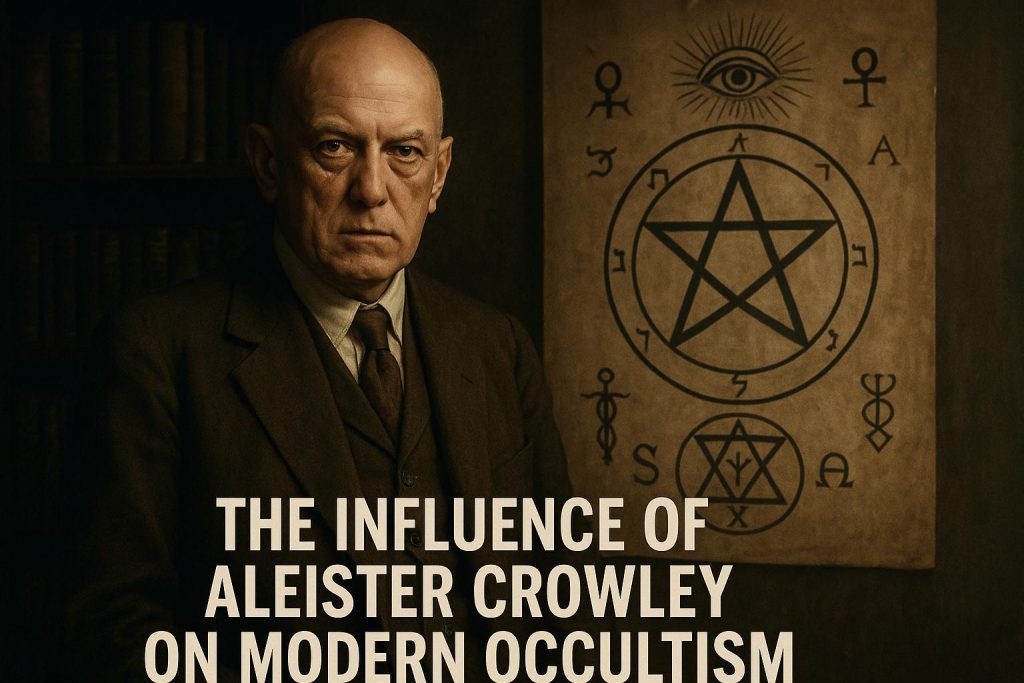
The Legacy of Aleister Crowley on Modern Occultism
Aleister Crowley, often referred to as “The Great Beast,” is a figure whose impact on modern occultism is both profound and controversial. As a prolific writer, ceremonial magician, and founder of the religious philosophy of Thelema, Crowley’s influence can be seen in various modern spiritual and occult practices. Understanding Crowley’s legacy involves examining various aspects of his life and influence on contemporary spiritual practices.
Early Life and Introduction to the Occult
Aleister Crowley’s journey into the realms of mysticism and the occult began in the late 19th century. Born in 1875, Crowley was raised in a strict Christian household that adhered to the principles of the Exclusive Brethren, a conservative evangelical sect. His upbringing in this rigid environment played a significant role in shaping his later quest for esoteric and mystical knowledge. This rebellion against the constraints of his early life fueled Crowley’s exploration of alternative spiritual pathways.
During his time at the University of Cambridge, Crowley began to indulge his curiosity about the occult. It was here that he immersed himself in the study of mystical literature, ranging from ancient texts to the works of modern mystics. The intellectual freedom he experienced at Cambridge allowed him to pursue these interests without the restrictions imposed by his upbringing. Eventually, this exploration led him to join the Hermetic Order of the Golden Dawn, a prominent organization dedicated to the study and practice of the occult.
The Formation of Thelema
Thelema, a spiritual philosophy formulated by Crowley, stands at the core of his legacy. This belief system places primary importance on the concept of finding and following one’s true will, free from external impositions. The central tenet of Thelema, “Do what thou wilt shall be the whole of the Law,” signifies more than just indulgence in personal freedom; it represents a spiritual journey and an inward exploration of the self.
Thelema drew upon a variety of religious and philosophical ideas, synthesizing them into a unique worldview that resonated with followers seeking a break from conventional religious doctrines. Crowley’s vision emphasized personal sovereignty, encouraging individuals to explore and develop their spiritual and mystical capabilities. The philosophy of Thelema has found resonance in various modern neo-pagan and esoteric movements, influencing both leaders and followers in these fields.
Crowley’s Written Works
Throughout his lifetime, Crowley was a prolific writer who produced an extensive array of texts on topics ranging from magic and mysticism to philosophy and religion. His works, such as The Book of the Law, Magick in Theory and Practice, and The Equinox, serve as foundational texts for many contemporary occultists. Each text provides insight into Crowley’s personal journey and the development of his philosophical and mystical ideas.
Crowley’s writings are characterized by a synthesis of Eastern and Western spiritual traditions. He was heavily influenced by Eastern philosophies, including Buddhism and Hinduism, and integrated these with Western esotericism to create a comprehensive system of thought that challenged traditional spiritual paradigms. His work often encourages readers to explore the depths of their personal beliefs and spiritual practices, serving as a guide for those on a path of self-discovery.
The impact of Crowley’s written works extends beyond just the realm of occult practitioners; they challenge readers to question and redefine their understanding of spirituality and their place in the world. Crowley’s emphasis on personal exploration and experimentation has inspired many to pursue their own spiritual journeys in search of deeper truths.
Impact on Modern Practices
The influence of Aleister Crowley can be observed in numerous modern spiritual practices, particularly within the sphere of Western esotericism. Central to his impact is the development of ceremonial magic, which has inspired practices utilized by various modern magical orders and individual practitioners alike. Crowley sought to demystify and codify magic as a discipline, providing structure to what he viewed as an ancient and profound spiritual tradition.
Moreover, elements from Crowley’s teachings have permeated popular culture, contributing to a broader public interest in mysticism and the occult. Crowley has been referenced in music, literature, art, and even film, proving the enduring allure of his persona and ideas. His life and work continue to captivate and inspire a diverse range of individuals who seek to explore alternative spiritual and esoteric paths.
The teachings of Aleister Crowley remain influential, continuing to intrigue and inspire those interested in the mysteries of the occult. For those wishing to delve deeper into Crowley’s work, a wealth of resources and communities are available. These groups and texts provide insight into his teachings, fostering ongoing dialogue about their relevance and application to modern spiritual and occult practices.
In summary, Aleister Crowley’s legacy on modern occultism is multifaceted and enduring. From his early divergence from Christian doctrine to his prolific writing and formation of Thelema, Crowley’s impact is embedded within both the modern spiritual milieu and popular culture. His persistent emphasis on individualism, introspection, and the pursuit of true will continues to resonate with those exploring new dimensions of spiritual expression. Guided by his works, many are led to question and redefine not only their spiritual beliefs but also their understanding of personal freedom and self-discovery.