
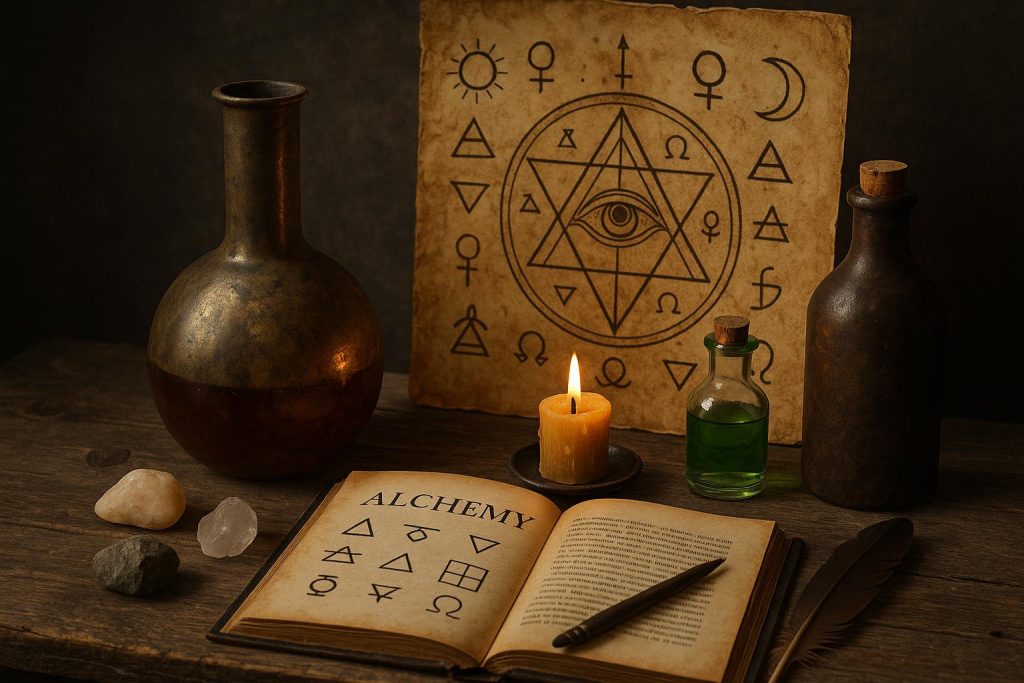
Understanding Alchemy: More Than Just Transformation
Alchemy is frequently perceived as the mystical art of converting base metals into gold. However, this represents only a fraction of its historical and cultural significance. Beyond being an antecedent of contemporary chemistry, alchemy is a deep spiritual tradition that seamlessly blends science, philosophy, and spirituality, offering profound insights into both tangible and intangible realms of existence.
A Brief History of Alchemy
The origins of alchemy extend back to ancient civilizations such as Egypt, China, and India. In these early cultures, alchemists pursued a profound understanding of the natural world and the essence of life itself. Their practices were steeped in mysticism and an early form of scientific inquiry.
As the knowledge of alchemy spread during the Hellenistic period, it made substantial inroads across the Mediterranean basin. Alchemy thrived particularly within the Islamic world, wherein scholars and practitioners expanded its methodologies and interpretations. This rich body of work finally made its way into medieval Europe, where alchemical teachings were absorbed, adapted, and transformed by a new generation of European thinkers, philosophers, and mystics.
The Dual Nature of Alchemy: Physical and Spiritual
Alchemy’s complexity lies in its dual nature—comprising both practical and spiritual dimensions. The practical aspect of alchemy revolves around experimentation with various substances. Alchemists engaged in extensive research to transform materials, changing their properties through chemical processes. This empirical side of alchemy contributed to the foundation of modern chemistry, offering early insights into the transformative capabilities of chemical reactions.
On the other hand, the spiritual aspect is equally significant, enveloped in symbolic and esoteric wisdom. Alchemy’s spiritual dimension is not merely concerned with material transmutations but emphasizes the inner transformation of the individual. It is a metaphorical journey towards self-enhancement, enlightenment, and achieving a higher state of consciousness.
A notable goal of these spiritual alchemists was the creation of the Philosopher’s Stone. While physically, this stone was believed to possess the miraculous capability to convert base metals into gold and grant eternal life, its symbolic analogy reflects the transformative journey of the soul towards enlightenment.
The Symbolism in Alchemical Practices
Symbolism in alchemy is both intricate and profound. The Great Work, known as Magnum Opus, stands at the heart of alchemical tradition. This quest for transformation is a cornerstone of alchemical belief, encompassing both a literal and a metaphorical journey. The alchemist’s path is marked by distinct stages, including Nigredo (blackening), Albedo (whitening), Citrinitas (yellowing), and Rubedo (reddening).
Each phase represents both a physical process applied to substances and a metaphoric journey towards personal and spiritual enlightenment. Nigredo symbolizes the chaos and decomposition necessary for transformation. Albedo reflects purification and the illumination of the mind. Citrinitas is the dawning of wisdom and clarity, leading to Rubedo, the manifestation of enlightenment and the culmination of the alchemist’s spiritual endeavor.
The Connection to Spirituality
Alchemy’s profound connection to spirituality cannot be overstated. Practitioners of this ancient art considered the transmutation of mundane materials integral to purifying and perfecting their inner essence. Alchemists sought to unify the physical and spiritual realms, achieving personal transformation and becoming attuned to a higher existential purpose.
These concepts of inner transformation resonate with various spiritual and mystical traditions, which emphasize personal enlightenment and the realization of one’s higher potential and purpose. Alchemy, in this sense, becomes more than an esoteric practice; it is a journey toward self-actualization.
Even today, contemporary spiritual practitioners and enthusiasts frequently draw upon alchemical symbols and methodologies. They serve as metaphors for personal growth, self-improvement, and spiritual awakening. The enduring legacy of alchemy in modern spiritual discourse speaks volumes about its timeless relevance.
Moreover, for those with a keen interest in uncovering the philosophical aspects of alchemy or delving deeper into its historical antecedents, a wealth of resources and scholarly works are available. These resources offer a more comprehensive understanding of how alchemy intertwined with historical spiritual beliefs and how it continues to inspire those on a quest for inner transformation.
To explore alchemy is to embark on an intellectual and spiritual journey that encapsulates the mysteries of life, matter, and the human spirit. It reveals the interconnection between the quest for material change and the aspiration for spiritual enlightenment, highlighting the alchemical belief that transformation on any level reflects a fundamental process of the universe.