
The Historical Background of Pendulums in Divination
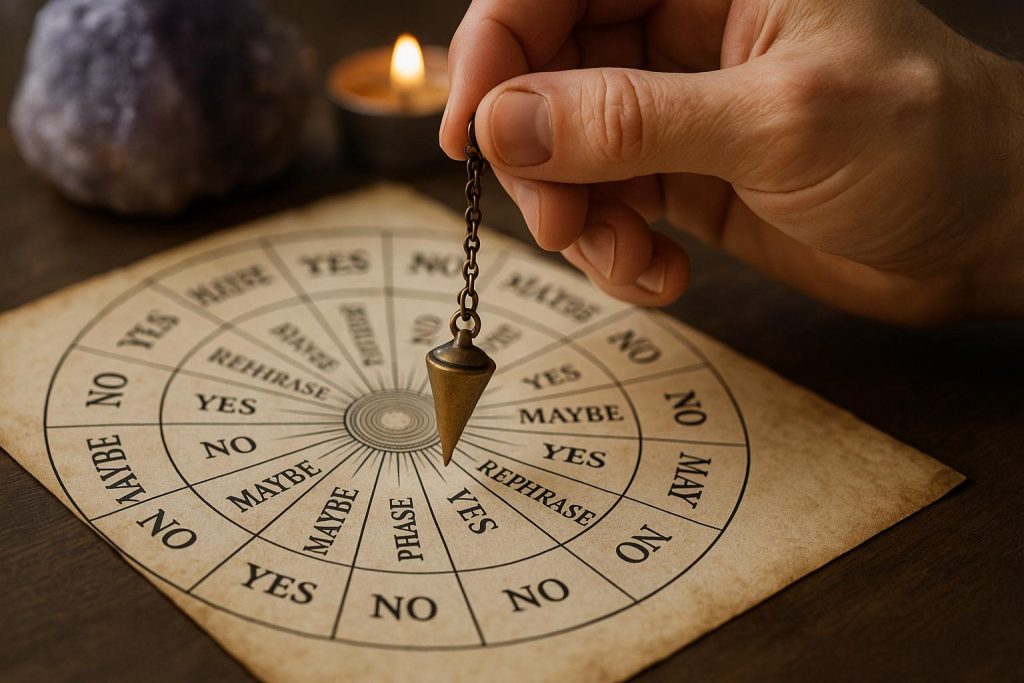
The pendulum has long been a tool in the practice of divination, a method used to seek insight into questions or situations. Historically, pendulums have roots in various cultures and have been utilized for spiritual and practical purposes. This device, often a weight suspended from a string or chain, can be simple or elaborately decorated, but its basic principle remains the same.
The Mechanics of Pendulum Dowsing
In the realm of divination, a pendulum is primarily used to answer questions by interpreting its movements, which are often seen as conveying messages from the spiritual realm or the subconscious mind. The practitioner holds the end of the string carefully, allowing the pendulum to swing freely. Its movements, such as circular or back-and-forth swings, are believed to provide insights. Some attribute these movements to ideomotor responses, which are subtle, involuntary muscular movements that occur without conscious effort.
The Nature of Pendulum Movements
When a pendulum is used, its movements are not just random swings. The practitioner interprets these movements as responses to their questions. The swings might move in circles, straight lines, or other configurations, each pattern carrying potential significance. While experienced users may have nuanced understandings of these movements, the essential principle relies on pre-established motions. The key belief is that these motions are influenced by external energies or inner consciousness, bringing guidance to the questions asked.
The Science Behind the Motion
Understanding pendulum dowsing involves both metaphysical and scientific perspectives. While spiritual interpretations regard the pendulum’s motion as a channel for messages, the scientific community explains these movements through the lens of physics and physiology. Ideomotor actions, for example, demonstrate how the body can produce movements based on subconscious intentions or thoughts, steering the pendulum without the person’s direct control. This fascinating intersection between the mind and body reflects broader themes in both psychology and spiritual studies on how humans interact with the world.
Common Applications
Pendulum divination has been applied in a variety of contexts, tapping into its utility and simplicity. It becomes a versatile tool for those who seek to uncover hidden knowledge or address uncertainty in their lives.
Locating Lost Objects and Seeking Answers
One of the frequent uses of pendulums is the attempt to locate lost objects. By asking direct questions and interpreting the pendulum’s movements, the practitioner hopes to narrow down possible locations. Similarly, pendulums are popular in decision-making processes where clarity is needed. Queries can be simple “yes” or “no” questions, allowing individuals to draw direction based on the pendulum’s swing that signifies a specific answer.
Utilization in Personal and Spiritual Matters
Beyond straightforward questions, pendulums are also embraced in more complex personal or spiritual inquiries. For those delving into personal growth or spiritual insight, a pendulum can offer a conduit for exploring deeper aspects of the self. The process involves engaging with one’s inner thoughts or spiritual beliefs, often leading to introspection and mindfulness.
Explorations of Health and Emotional Insight
In some traditions, pendulums serve a role in exploring health conditions or emotional states. While not a replacement for medical advice, it is used as a complementary technique to assess areas that might require attention. This aspect of pendulum usage ties into a broader holistic approach where physical and emotional wellbeing are interconnected with spiritual practices.
Interpreting Pendulum Responses
Accurate interpretation of a pendulum’s responses is essential for deriving meaningful insights. This requires practice and familiarity with one’s personal connection to the pendulum, gaining a deeper understanding over time.
Establishing Baseline Indicators
A significant step in pendulum use is the establishment of baseline indicators for interpretations. Typically, a practitioner will determine specific movements to signify “yes” and “no.” Often, this is personalized according to individual intuition or specific guidance received during practice. For some, a circular swing might indicate affirmation, whereas a straight line might mean negation.
Neutral Responses and the Call for Further Inquiry
Besides clear affirmative or negative answers, pendulum movements can sometimes represent neutrality or suggest the need for further questioning. Practitioners consider these movements as indicators that they may need to explore different questions or adjust their approach. This sometimes leads practitioners to refine their technique or deepen their meditation practices before continuing with their inquiries.
Preparation and Practice
The practice of using a pendulum involves more than just the mechanics of swinging it. Preparation often enhances effectiveness, as it aligns the practitioner’s focus and intention with their desired outcomes.
Preparatory Rituals and Intention Setting
Before using a pendulum, practitioners may engage in preparatory activities that focus their intentions. These could include meditation to quiet the mind or grounding techniques to center one’s energy. Such rituals are not uniform; they may vary based on personal preference or tradition. The underlying goal is to create a conducive mental and emotional state for divination.
Calming Exercises and their Role
Calming exercises, including deep breathing or visualization, often precede pendulum use. They serve to reduce distractions and clear the mind, allowing practitioners to focus solely on their questions. These exercises form an integral part of the practice, potentially enhancing the clarity and accuracy of the pendulum’s guidance.
Exploring Broader Resources
For those new to pendulum divination, exploring additional resources can be invaluable. Books, tutorials, and online communities provide foundational knowledge and advanced techniques. Engaging with a community of practitioners is helpful, offering support and shared experiences in the journey of mastering pendulum use.
Approaching pendulums with an open mind and a curiosity for their potential can enhance one’s experience. The historical significance and various interpretations that surround pendulum usage add depth and appreciation for this divinatory tool. Personal experience and practice remain essential, highlighting that each journey with the pendulum is unique. While outcomes can differ across users, the lessons learned and insights gained hold personal value, thus encouraging continued exploration in the art of pendulum divination.